
Stand and Deliberate
Why Teach? — Peter Shull | Self-published; 228p; 2024

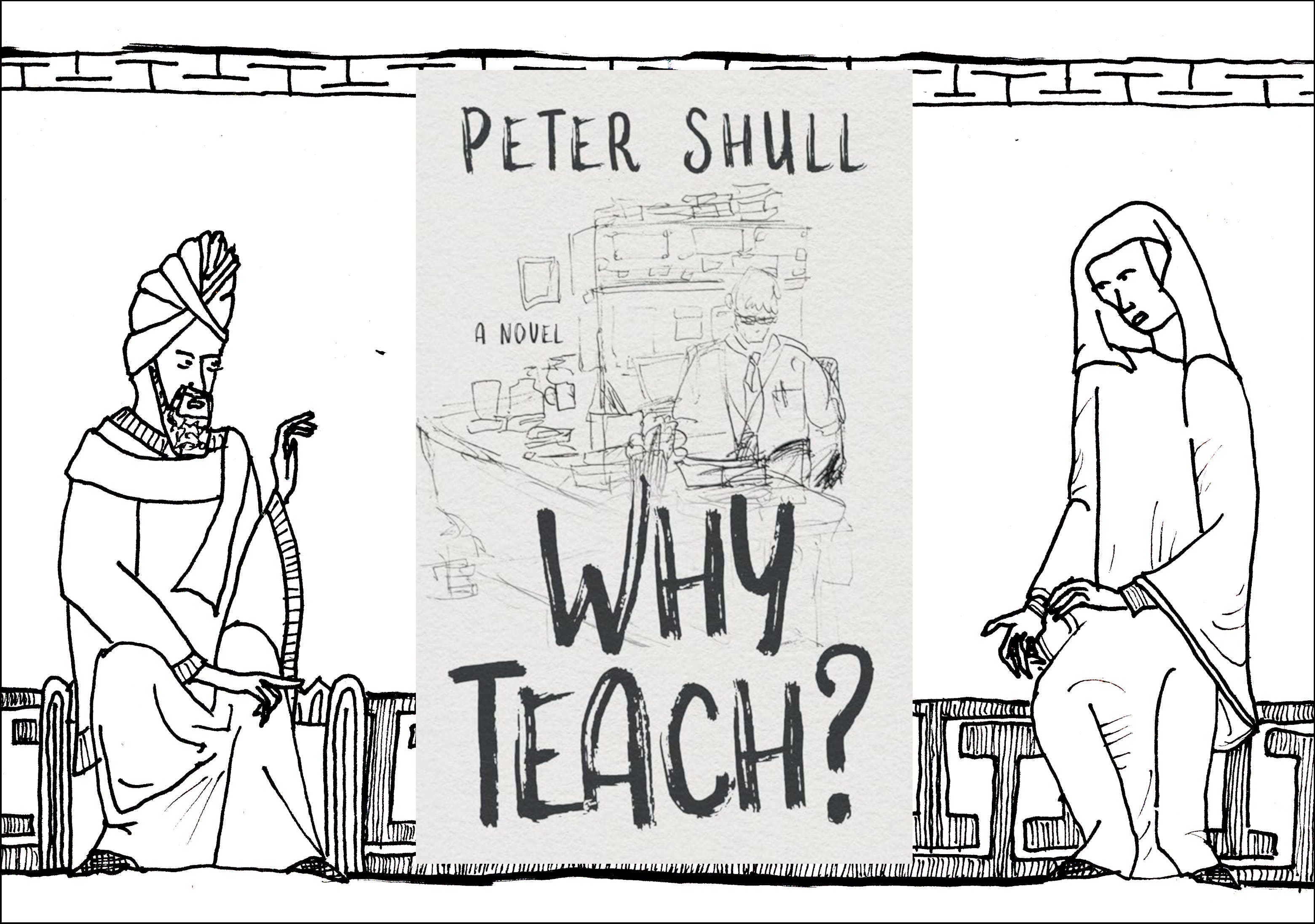
This week’s post, our twentieth following our review of Lara Mimosa Montes’s The Time of the Novel, features Peter Shull’s Why Teach?, self-published in 2024 on his ad hoc LLC, Lower Midlist Publishing. The novel was also serialized on his Substack.
It may seem that there are many various paths to becoming an English teacher, but most of them tend to share a certain underlying structure. I was born the last of six to an engineer and a special education teacher in a small town south of Buffalo. I attended a tiny, underfunded Catholic school that employed mostly well-meaning teachers of highly variable levels of competence and interest. I did not have any transformative educational experiences, nor did I particularly care for literature until my senior year, when I read No Country for Old Men and The Last Tycoon and The Catcher in the Rye as part of a required at-home reading program.
When I arrived at a public liberal arts college near Rochester for undergraduate, I harbored dreams of being a filmmaker despite never having shot more than a clip of video on a Motorola Razr. A confluence of factors—a girlfriend, a tendency toward indecision, there being no filmmaking program at my university—directed me toward a compromise: I would major in psychology and minor in film studies, making a respectable salary as an industrial/organizational psychologist that I could then parlay into my real passion—cinephilia. The next couple of years eroded this resolution. I found the business classes compulsory to an I/O focus vulgar and anti-intellectual, I developed anxiety and depression, and I was bathed in the existential dread of having committed my only life to a predominantly practical end. In the Fall of my senior year, I hurriedly researched English graduate school programs. I’d spent much of my free time the previous few years studying literature outside of class, and I’m not sure I even realized there were doctorate programs dedicated to film studies. I informed my advisor of my desire to switch my major to English and apply for PhD programs, but it was impossible to fulfill the major within a single year and still finish the few classes necessary to my psychology major. I was stubborn, though, and was able to attain a minor in English and a senior thesis to build out some bonafides for my résumé. I applied to about a dozen state university PhD programs and got into a few, mostly after being waitlisted. I chose Penn State University in large part because it offered the most sizable stipend—around $15,000 annually for six years, and no tuition costs.1
By 2012, anyone who decided to attend a doctorate program in English at a state university in the absence of a trust fund (which neither I nor any of my peers had, to my knowledge) was committing to a quixotic venture. The advisor of my undergraduate thesis, who got his PhD at Maryland in 2002 and received a tenure-track offer the following year, had discouraged my graduate school ambitions with admirable candor. Not only were there few salaried positions left, there were virtually zero for a white American studying modern anglophone literature. He more or less warned me that if I ended up using my degree at all, it would be as a high school teacher.
I’d be lying if I said I didn’t still nurture some feelings of exceptionalism—even if there’s only one job in post-45 American literature when I reach the market in six years, my passion and talent and work ethic will make me the strongest candidate for the position—but I also prepared myself psychologically for the prospect that there would be no academic job at the end of the journey. I asked myself whether six years dedicated primarily to the life of the mind, with a couple sections of writing seminar teaching responsibilities to earn that sweet stipend, would be worth it even if I ended up in a career I could have begun four or even six years earlier, with only a bachelor’s degree. I decided it was.
My senior advisor was right; so was I. Despite publishing several scholarly articles—more than some of my undergraduate professors had in the last decade2—I spent two post-doctoral years on the job market without even an interview. This included post-docs, non-tenure-track positions, visiting professorships, digital humanities posts. At 30 years old and yet to gross more than $25,000 in a tax year, I reluctantly accepted the end of that dream. I supposed I’d have to be an overqualified high school teacher. I had perhaps arrogantly presumed that although it was a diluted version of the life of the mind I’d aspired to, there would at least be a nigh infinite number of jobs available.
What I soon discovered was that the highest degree in English literature and eight years of teaching undergraduate English does not qualify you to teach adolescents. Pennsylvania required an 18-month certification program that would cost tens of thousands of dollars. Most other states were variations of the same. I was certain there must be an alternative path to accreditation for those holding an advanced degree in their teaching subject, but, despite the supply of teachers being so bad that Florida passed a law allowing retired veterans and police officers to teach without certification, there was simply no way around the red tape. Having spent nearly three decades of my life in school and with a net worth in the five digits, there was no way I was going to be forced to pay to learn how to practice something I’d been successfully doing for the past eight years.
It is perhaps a symptom of a broken system that someone with a doctorate in English and years of teaching experience was compelled to apply to teach in private schools because the public schools wouldn’t have him. Although I was pretty sure that many private schools would pay better than publics, a large part of my turn away from business and the corporate world was the intention of a more civically and democratically meaningful career. I didn’t imagine myself in inner-city Philadelphia, but nor had I planned to share my abilities exclusively with the children of the elite. Although the private school job market was much tougher for someone without high school classroom experience than I expected, I received a couple job offers and accepted a position at a school in Miami, where I would make a modest salary that was also several times more than I’d ever made in my life. It was one more compromise.
I’m a little bit suspicious of recognition and identification as primary virtues of art. It reminds me in an oblique way of when I came across video games like American Truck Simulator and amusedly wondered who these could be made for. The answer was harrowing: it turns out that a substantial number of long haul truckers spend their hard-earned hours away from the wheel playing truck simulator video games, hauling cargo across I-70 in their Western Star 57X. This isn’t to say that I only seek out alterity in art, just that too much identification can feel either embarrassing or masturbatory, collapsing the distance necessary to aesthetic perception.
Peter Shull’s Why Teach? is a novel that strains my comfort with such proximity. It tells the story of a twenty-something Kansan who loves literature, who had an existential crisis in college and romantically abandoned his law school ambitions, who became a high school teacher somewhat inadvertently, who experiences teaching literature as a distressingly compromised and thankless vocation despite its ostensible virtues being that it is less compromised and more meaningful than most other careers. Although there are many differences between my story and narrator William Able’s—his family is wealthy and he is thus more directly forsaking a life of comfort for one of meaning; he teaches a diverse student body at a public high school—the resemblance is unmistakable, and I imagine many other English teachers will agree. There is much to admire in Shull’s almost single-minded effort to dramatize this plot, to give it more dignified form than it tends to receive on television and in movies, which usually feature a scene in which the teacher breaks through to his black and brown students by freestyling about Shakespeare.
Indeed, most narrative representations of high school teaching suck.3 Shull reveals in his acknowledgments that Why Teach? was inspired most directly by (college) campus novels such as Wonder Boys and Straight Man. Successful narratives of this type considerably outweigh those of the K-12 genre, for some obvious reasons. The college professor has considerably more time for, and expectation of, an independent life of the mind as expressed in scholarship, often to the point that the professor, both actual and fictional, is a scholar first and a teacher second. This allows for more freedom to explore ideas, and often to directly represent the tension between sophisticated intellectual activity (represented by scholarship and lectures) and the world of practicality (represented by indifferent students, overreaching administrators, and the world outside the campus). Further, the professor is of a social and (generally) economic class above the K-12 teacher, and thus can, say, be whisked off to another country for an academic conference or made to confront the material decadence of contemporary bourgeois life—generally a more agreeable fictional subject than lower middle-class despair. Finally, and perhaps most plainly, since the mid-20th century the higher education system has become the primary subsidizer of fiction writers, and thus published writers spend considerably more of their time around colleges than high schools. In other words, there are many more notable novels about professorial life because professorial life much more readily facilitates the writing of fiction than does the teacher lifestyle; moreover, the life of the professor is a more appealingly ideal balance between autonomy and necessity than that of the teacher, whose existence perhaps too closely resembles that of the working class, albeit without even the allure of authenticity. This is, I think, the central challenge and the primary appeal of Why Teach?, its effort to plumb the specific attractions and anxieties of a career that doesn’t fit easily into the PMC or the blue-collar molds.
It is interesting to learn from the acknowledgments section that the novel was originally written in third-person but, upon editorial advice, revised to first. My biggest problem of the novel is the lack of authorial distance from the narrator. This is of course not to say that the novel is autobiographical and William Able a stand-in for Shull; my point is rather that there is little sense of irony, dramatic or otherwise. Able is almost perversely lacking in perversity; on the rare occasion he has an ungenerous thought or commits a callous action, he almost immediately recognizes it and walks us through his requisite guilt. Shull tries to manufacture some warts—Able comes from a privileged class background; he’s perhaps a little ignorant about the demographic homogeneity of the canon—but these are not exactly character flaws.
I sought out Why Teach? largely on the strength of Shull’s more recent story “Prague,” which I raved about elsewhere. It is not always productive to pit an author’s work against each other, but I think the comparison is revealing. The narrator of “Prague” is an undergraduate English major, his personality and voice not markedly different from William Able’s. What sets the two works apart is that the narrator of “Prague” is not the protagonist, really; as in Lord Jim and The Great Gatsby, the fairly unremarkable narrator is compelling primarily in his relation to the hero, a precocious, eccentric writer named Leo Brenning. There is no Leo Brenning in Why Teach?, no character as memorable or vividly drawn as Brenning, and no obsession to provide a necessary degree of perversity to the narrator. This is not to say that the observer-hero narrative is the only solution, but in “Prague” it’s employed masterfully in Shull’s hands. In that sense, the ultimate impression left by Why Teach? is excitement by how rapidly Shull has advanced as a storyteller.
Perhaps the most peculiar and, in my mind, disappointing fact of the novel is that it is essentially historical. Set at some point not long after the 2008 financial crisis, it is a Bush-era novel in terms of public education policy. Of course, the legacy of the No Child Left Behind Act persists: Able’s battles with standardized testing and “data-driven accountability” will be recognized even by private school teachers. On the other hand, many aspects of Able’s high school, his students, and the curricular conflicts now seem quaint.
Shull’s Able is, in terms of literature, rather conservative. This is rather credible, I suppose, for a twenty-something Kansan, and as someone with a provincial background I say that without condescension.4 The Great Books Able is bent on protecting are rather unimaginative, the books that American high schools have been teaching for decades out of custom more than intention. Huck Finn, The Scarlet Letter, To Kill a Mockingbird, The Great Gatsby, Of Mice and Men, Death of a Salesman, Romeo and Juliet. I like all of these books (two of which I have not myself read since middle school), but their predictability also suggests a remarkable lack of experience or, worse, curiosity. Although Able is ostensibly defending the novel (and the play) — the teaching of the “whole book” as opposed to decontextualized excerpts of prose — it is a rather cribbed, musty conception of the form.
In one scene, Able looks back fondly on a group project he participated in as a freshman, creating scenes from The Odyssey out of cardstock, tissue paper, paint. He offers this as an educational experience outside of the capture of efficiency-driven best practices, one that a superintendent would surely seek to eliminate:
What standards and benchmarks might Mrs. Hirsche have ticked off on her clipboard had she walked into that class? Students Work in Collaborative Teams? Students Appreciate Mythological Context? I doubted Mrs. Hirsche or any of our administrators would have smiled on Mrs. Unger’s use of class time that day, but to me, now, it seemed that we had Made Art, and, perhaps even more importantly, Made Friends.
Able’s complaint would be addressed, to an extent, by the Obama era and the embrace of social-emotional learning (SEL); as you might know, this has not been a panacea. Not only does SEL demonstrate that seemingly ineffable experiences such as “make friends” can be reduced to measurable educational standards, it also threatens to de-intellectualize the classroom in politically suspicious ways. As Daniel Gonzalez asks in his excellent “The Work of Feelings in Public Schools,”
If the first principle of curriculum meetings is to find ways to use texts as vehicles for belonging and social emotional skills, one has to ask: does this curriculum serve students who seek a quality public education?…Public schools that design curriculum to focus on belonging and social emotional skills are training students for low-wage jobs—and non-ironically calling this training equity and inclusion.
Similarly, the Trump-era culture wars are necessarily excised from consideration by the novel’s choice of setting. At one point in the past decade, Able might have been defending To Kill a Mockingbird not against the whole book police but parents and colleagues questioning the precedence of a white woman’s take on Jim Crow over that of a black author. At another point in the recent years, Able might have had to wrench To Kill a Mockingbird loose from the hands of the PTA president demanding a purge of the school’s woke curriculum. Instead, we get only a brief exchange with Lauren West, a fresh-faced colleague who blithely pwns Able with a feminist, anti-racist critique of the canon. (It doesn’t help that Able can’t recall Lorraine Hansberry’s last name or that of her canonical play). That West has allied herself somewhat with the curriculum-destroying Head of Literacy dismays Able, but the poultry raised by the conversation never come home to roost.
With a novel of this kind—that is, the kind that foregrounds its central question as its title—you already know it will conclude with some kind of re-commitment to teaching; what’s in doubt is how that conclusion will be reached. For Able, the various forces that compel him to delay law school and stick it out one more year, at least, are myriad and amorphous: a revulsion of the empty, meretricious values dominant among the upper class; the small differences one can make in a young person’s life; pure, unmitigated spite. Well, shit—it feels like I’m actually driving this big rig!
I was in fact able to live comfortably enough on this salary without loans or parental support; State College is a relatively inexpensive place to live, and you could earn a couple extra thousand teaching during the summer.
I say this without arrogance or self-pity; many of my peers also published plenty with the same results.
I loathe the phony romanticism of Dead Poets Society (the film), for one.
It is a little bit jarring when we learn that Able has not yet read Hamlet or King Lear or Othello.
This is one of the strangest, most Russian doll-ish reading experiences I’ve ever had. I’m a high school English teacher reading another HSET reviewing a novel about HSET’ing by another HSET. It’s like being a trucker watching another trucker stream a third trucker’s big-rig simulation sesh on Twitch.
I enjoyed Why Teach?, which I read while it was being serialized on his Substack newsletter, but yeah, Prague was on a whole other level. Great fun to see the evolution of a writer in real time.
Now I'm stuck wondering if the editorial advice was wrong, and the novel might have been stronger with a third person POV.