
The Blank Generation
Anika Jade Levy - Flat Earth; Catapult; 224pp; 2025

This week’s post, our eleventh following our review of Moez Surani’s The Legend of Baraffo, features Anika Jade Levy’s Flat Earth, released this past November by Catapult. Founded in 2015 by Andy Hunter and Elizabeth Koch, Catapult has published the likes of Jesse Ball, Lauren Oyler, Zachary Lazar, and Jordan Castro. Catapult is also the name of the parent company whose imprints also include Counterpoint and Soft Skull. In 2023, the New York Times profiled Koch, the daughter of billionaire Charles Koch.1
Even across the ocean, the simulation flapped like a flag in the sky, rippling with the moon and red sun and the stars, and a sign on the side of the road was spray-painted (what else?) with the words that had made it everywhere, FLAT EARTH.
—Patricia Lockwood, No One Is Talking About This
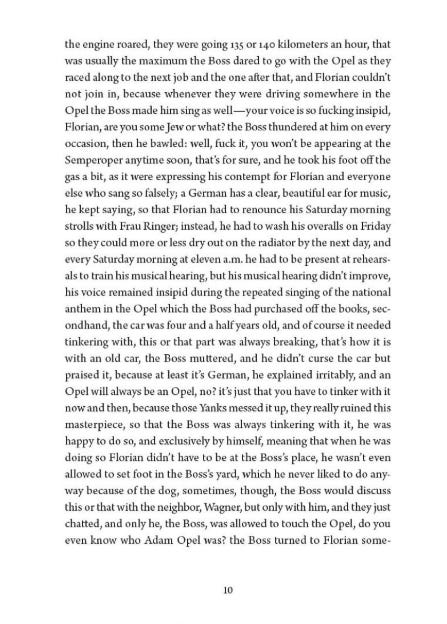
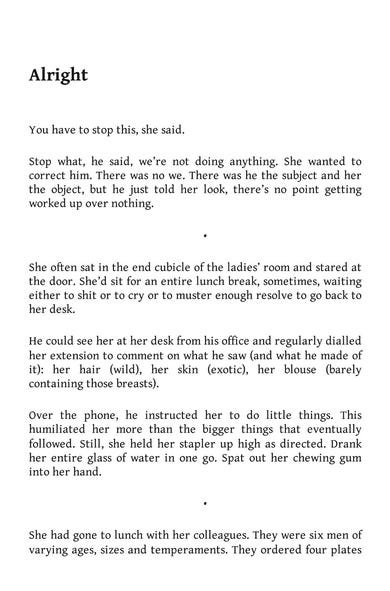
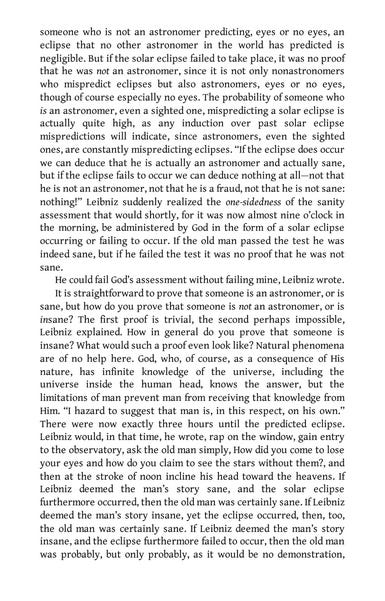
Increasingly, hip, often independently published novels can be classified along two poles—extremes having nothing to do with reading but looking, not the language itself but the ratio of squiggles to blankness.
Here is a page from László Krasznahorkai’s Herscht 07769 (2021/2024):
Here is a page from Natasha Brown’s Assembly (2021):
Here is a page from Adam Ehrlich Sachs’s The Organs of Sense (2019):
Here is a page from Anika Jade Levy’s Flat Earth (2025):
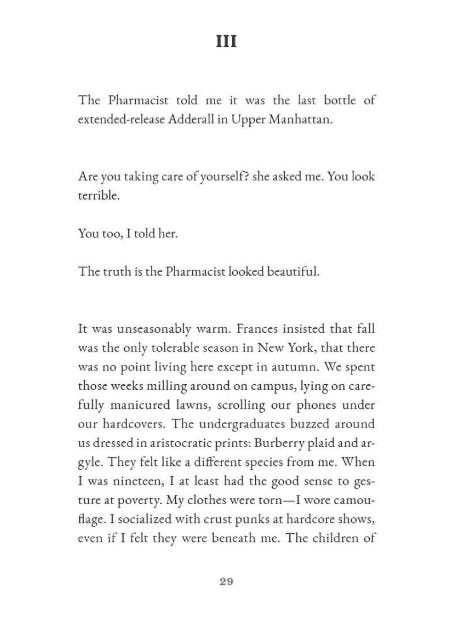
You could trace the antecedents of each strain: Canetti, Bernhard, Sebald on one end; Adler, Hardwick, Offill on the other. You could also attribute moral weight to each: the former resists the attention economy, demanding sustained attention; or, it is a phallic, neo-modernist assertion of male entitlement to your time. The latter captures the fragmented consciousness of contemporary life, especially of the Internet era, finding the immanent poetry in prosaic detritus; or, it is a repackaging of the social media feed for literary poseurs, permitting the marketing of 30,000 words of diaristic diarrhea as a 224-page novel.
To do so, however, would be to engage only in meta-criticism and evade the specific criticism of a particular book. This is tempting to do in assessing Anika Jade Levy’s Flat Earth, as it resembles so many other works, including many of the “blank” novels referenced above. But is (the) resemblance derogatory?
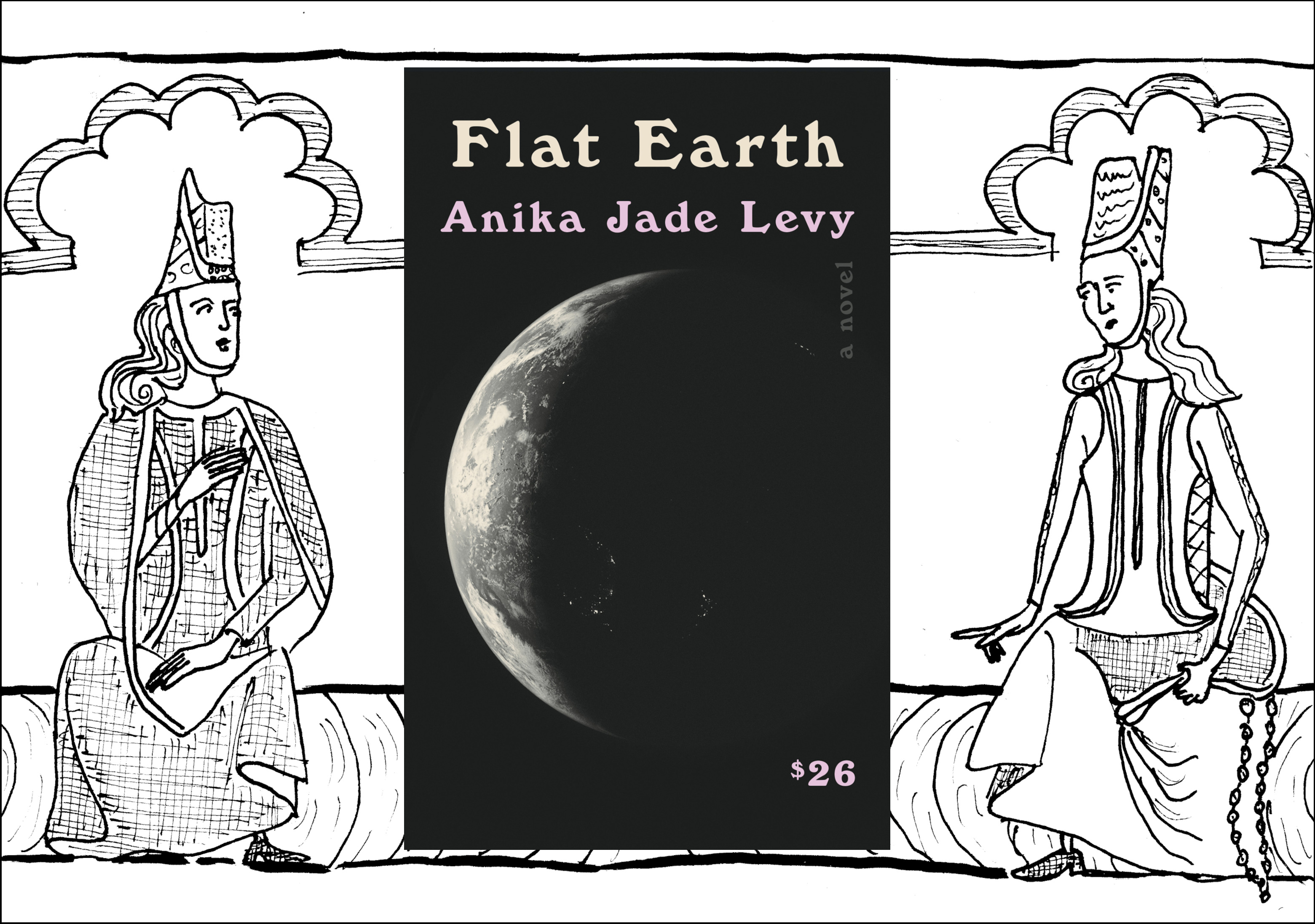
Let it not be said that literary fiction is not a genre, or at least that it does not contain its own sub-genres. Reading Flat Earth is not unlike reading a detective novel or watching a horror film — not only is almost everything on the page (or the screen) familiar, but so are its rules, its syntax. The pleasure, to the extent that such a work is successful, comes not from defamiliarization or invention but effective arrangement, artful tweaks to the formula.
A little bit ago, John wrote about Sonya Walger’s Lion (2025), which he placed within the genre of “fragment novel” alongside the work of Sheila Heti and Jenny Offill. He borrowed the label from Becca Rothfeld, who used it to discuss novels of this type that are also “internet novels,” works that are not only about the Internet but which attempt to replicate the feeling of being online. Although I seem to like Patricia Lockwood’s No One Is Talking About This and Jenny Offill’s Weather more than she does, she is correct that this formal approach has become by this point mannered, limiting, and perhaps suspiciously popular. And, as you can already imagine, many of these “fragment novels” are also blank novels, an economy of words more consistent with chapbooks.
Here is the overture to Flat Earth:
In August, all the pharmacies in New York run out of Adderall: A supply chain breakdown. A fraught relationship with China. A shipping container full of Estonian girls. In the absence of Adderall, all the girls in my class gain weight. The libraries go empty. We all cry constantly. Some of us take vows of celibacy. Many of us pretend to be Catholic, but only two join a convent. Everyone calls their mother on the phone compulsively. I take a handful of caffeine pills. I take a 5-hour Energy. I mail the rent eight days late. I reward myself with a nap.
Right-wing nutrition fads fall into fashion that year: an uptick in bovine meat, unpasteurized dairy, seed-oil skepticism, vaccine hesitancy. Hem lengths are going down again.
Here are the opening lines of Adler’s Speedboat:
Nobody died that year. Nobody prospered. There were no births or marriages. Seventeen reverent satires were written—disrupting a cliché and, presumably, creating a genre. That was a dream, of course, but many of the most important things, I find, are the ones learned in your sleep. Speech, tennis, music, skiing, manners, love—you try them waking and perhaps balk at the jump, and then you’re over. You’ve caught the rhythm of them once and for all, in your sleep at night. The city, of course, can wreck it. So much insomnia. So many rhythms collide.
Here are the opening lines of Madeline Cash’s “The Jester’s Privilege”:
I live above a fish market in Chinatown. East Broadway smells like hot blood. Except in the winter when it smells like cold blood. You can buy anything in Chinatown like lobster or crab or squid or shark fin or PCP or a fake Burberry sun hat. I have never been to regular China. For breakfast I pop a handful of pistachios—a highly-caloric nut—into my mouth, chew, then spit them out into a dish towel. Then I fill a dropper with 6ml of Metacalciquin intended to increase metabolism and shoot it down my throat. I do this every day. I find that it’s best to do the same things every day to avoid decision fatigue. My vision blurs for about ten minutes, a common side-effect of the Metacalciquin, so I make my way to my desk by groping the walls.
Here are the opening lines of Tao Lin’s “Love is a Thing on Sale for More Money Than There Exists”:
This was the month that people began to suspect that terrorists had infiltrated Middle America, set up underground tunnels in the rural areas, like gophers. During any moment, it was feared, a terrorist might tunnel up into your house and replace your dog with something that resembled your dog but was actually a bomb. This was a new era in terrorism. The terrorists were now quicker, wittier, and more streetwise. They spoke the vernacular, and claimed to be philosophically sound. They would whisper into the wind something mordant and culturally damning about McDonald’s, Jesus, and America—and then, if they wanted to, if the situation eschatologically called for it, they would slice your face off with a KFC Spork.
I won’t go on, despite having also collated extracts from American Psycho and My Year of Rest and Relaxation. What should be obvious is that Flat Earth is participating in a genre with hallmarks that go beyond the aesthetic facts of the material page. Levy is interested in describing the zeitgeist, in name-brand drugs, in New York decadence, in the economic underpinning of changes in cultural politics and manners.
She does so through her narrator Avery, a media studies graduate student whose episodic life we follow for a year. The novel’s events are mostly dates and sexual encounters with two men—the Law Professor and the Sculptor—as well as interactions with her wealthier, more successful best friend Frances. In addition to the above overture, each chapter ends in a brief “cultural report” written in the authoritative collective first-person, ostensibly extracts from the thesis she is supposed to be writing. It is noteworthy that, except for narrative voice, these reports are often redundant with the narrative itself. The end of Chapter Seven includes the declaration that “In local news, a popular digital artist forms a conceptual online pedophile ring. Pedophilia is wrong! his detractors say. You’re just afraid of making complicated work! say the men from his art collective.” About fifteen pages later, Avery attends a party thrown by this art collective; it’s unclear to me what is gained by the repetition.
The specific shtick of Flat Earth — the levels on the autofiction-fragmentary-blank-internet-novel mixing board that get slightly rebalanced — is the emphasis placed on Avery’s interest in “regressive sexual politics,” the earnestness with which she finds she cannot theorize her way out of “compulsory femininity.” The young women in Flat Earth almost all lack inner lives (a diagnosis Avery’s therapist gave to her when she was young)—besides Avery, there is only the performative tradwife Frances and the “gallery girls” who flock around male power. Levy suggests that the neo-Catholicism and sexual conservatism of the moment is a reaction to the empty commodification of contemporary post-feminism, in which every date is a transaction and, as Frances says and Avery echoes, “all work is sex work.” The novel feels honest about “bad feminist” feelings, which in Avery’s case manifest as sexual masochism and self-infantilization.
The novel is also a kind of Künstlerroman manqué2, as Levy’s writing struggles are tied up not only with her dependence on men—her desire to be an object rather than a subject, described rather than describer—but her artistic subservience to and envy of Frances. Flat Earth names both the novel itself and the experimental documentary made by Frances, itself a kind of cultural report on Middle America grotesquerie that is cynically slurped up by the New York art world. Levy is constantly signaling to us that Avery, and by implication the novel which she is enunciating, lacks artistic independence at best and is derivative at worst.
This is another literary trend in which Flat Earth participates: a defensive anticipation of criticism. At one point, Avery shares an excerpt from her notebook:
What Kenneth Goldsmith said: The world doesn’t need any new writing, just new arrangements of writings.
Two more quotations—from Rachel Cusk and Sheila Heti—are shared, lines that call attention to the two authors’ obvious influence on Flat Earth. At another point, a man tells her “You could be Mary Gaitskill if you weren’t too embarrassed to be seen trying at anything.” Allusions to Joan Didion and Elif Batuman occur elsewhere. Levy seems to want us to know that she is aware of her own familiarity. This is a bit pointless—to the extent that Avery is trite, so is the novel; worse, it shortchanges Levy’s own abilities, asking us to appreciate the book not on its own but as an ironic failure.3
When I used the search function in my ebook reader to locate the Gaitskill reference, the first occurrence was on a page I hadn’t read — the blurbs. Justin Taylor name-checks Gaitskill, Renata Adler, Elizabeth Hardwick, Jay McInerney, and Sheila Heti before sincerely declaring that the novel is “unlike anything I’ve ever read before.” As I examined some time ago, blurbs are strategically used to affiliate early-career authors with other, established writers; in this case, the novel itself both echoes and ironizes its own self-presentation.
It is unfortunate that in many cases the worst aspects of a book are infinitely more generative of critical engagement than the best. The popularity of books like Flat Earth is not a conspiracy any more than is the popularity of Substack Notes or Discourse Twitter. Lockwood and Offill are very funny, quite smart, and talented prose stylists. Levy is perhaps a notch below these authors at this point in her career, but still plenty competent. There is an opening image of a young man with “short, dirty, uneven hair, as if it had been dreaded and then underaged to adapt to changing cultural attitudes.” After the power grid goes down in Las Vegas, Avery’s evocation of the skyline is inescapably mediated: “a pale halo of leftover light where the city was supposed to be, a television that had just been turned off.” A model’s arms are described, jealously, as “unreasonably thin.” To say that Flat Earth is very reminiscent of Lockwood, Offill, and Heti is inherently a criticism is to claim a categorical distinction between literary fiction and genre fiction. I don’t think this is the case, nor do I think it is pejorative to call No Country for Old Men a Western.
The novel is a pretty breezy read, perhaps too much like Frances’s money, which “eliminates friction.” If you enjoy No One Is Talking About This and Weather—if you enjoy the Internet—you will probably find yourself chuckling every few pages (every couple hundred words). If you enjoy Ottessa Moshfegh and Mary Gaitskill, you will probably find the “debased e girl”4 descriptions interesting. That you could be reading someone who has already cleared the particular paths Levy treads is not a devaluation of her writing, even if the novel seems less certain of that.
I wrote up this little blurb after completing my review, but it’s amusing to note that Flat Earth’s Frances could be read as a(n unintended) reflection of Koch: “Her father inherited a shipping empire and three fisheries….School was expensive, but the universal sentiment in our department was that any art made outside of the flattened world of genuine economic necessity was insincere. So if Frances was going out with strange men for money it was only a jagged assimilation.” I think starting a small press is on the more benign end of inheritance expenditure, but it’s worthy of pause-taking. For a consideration of these complexities, see this piece by Hilary Plum and Lucy Biederman.
A linguistic hodgepodge for which I could not find a more linguistically consistent substitute.
There is a reactionary undertone to the novel that recalls Bret Easton Ellis, the Didion of “Slouching Toward Bethlehem”—a recurring assertion that the absurdities of the present, many of which are products of liberal cultural politics, signal the “end of the world.” Levy doesn’t trust the reader—perhaps understandably—and forestalls this cavil: “We tell ourselves that our neurosis about aging is in fact anxiety about the end of the world.” One assumes Levy has read David Foster Wallace’s review of John Updike’s Toward the End of Time.
h/t John Schneider
The Speedboat Industrial Complex